Sometimes we believe joy depends on everything being okay
For a long time, I thought joy was the natural result of things going my way. If I had peace, there was joy; if I had stability, there was joy; if I had no problems, I could breathe easy.
But life rarely works that way.
There are seasons where you do the right thing, and yet, things get complicated. Moments where obeying God doesn't spare us from exhaustion, injustice, or the feeling of being trapped in circumstances we didn't choose.
And that’s where the uncomfortable question arises: What happens to joy when life feels like a prison?
Paul and Silas: Singing where no one sings
The story of Paul and Silas in Acts 16 always confronts me—not because it’s extraordinary, but because it’s deeply human.
They weren't in prison for doing something wrong. They were there for obeying—beaten, shackled, publicly shamed, and locked in the darkest part of the dungeon.
And yet, the Bible says: they were praying and singing hymns to God..
Honestly, my first thought is: they weren't denying reality, nor were they faking that everything was fine. They were choosing a posture of the heart, and that challenges me deeply.
I realized then that the joy Scripture speaks of is not a fragile feeling,but a way of looking at life with eyes fixed on God, even when circumstances don't change and we don't have an immediate answer.
This kind of joy is only learned when we decide to live out our faith in the mundaneven when circumstances do not change immediately.
Joy is not an emotion; it’s a direction of the heart
I have often confused joy with enthusiasm, high spirits, or emotional energy.
But biblical joy is something else. It is an internal decision born from knowing who is holding my life, even when I don't understand what’s happening. Paul and Silas had no guarantee they would be set free. They didn't know an earthquake was coming.
All they had was God. And that was enough to pray, to sing, and to stand firm.
This joy isn't manufactured; it is cultivated in communion with God—in constant prayer and a living relationship that shapes the heart over time.
The “suddenlys” that shake everything
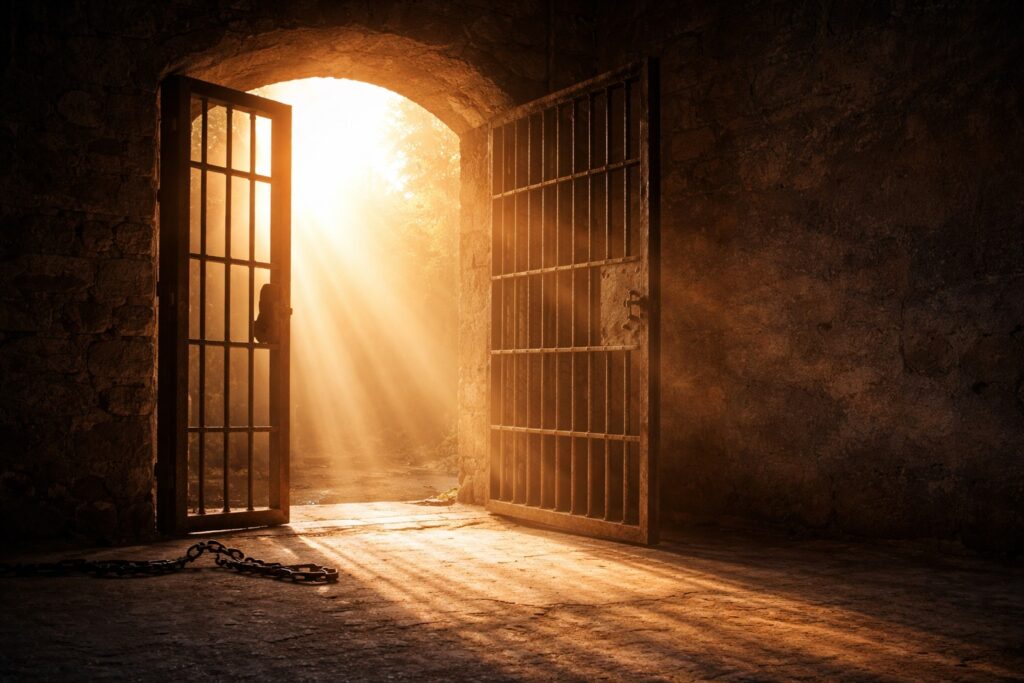
The story takes an unexpected turn. An earthquake shakes the prison. The doors fly open. The chains fall off. Everything changes in seconds.
Life is also full of these "suddenlys": a diagnosis, a loss, an economic crisis, or a conversation we didn't see coming.
Some earthquakes set us free; others upend us. But what strikes me is that Paul and Silas’s joy was there before the earthquake.It didn't appear after the miracle; it was already present in the middle of the prison.
It makes me wonder how many times I have conditioned my joy on God resolving things first, when perhaps He wants to form something in me before changing my circumstances.
When joy becomes a testimony
The story goes even deeper because Paul and Silas could have fled. The doors were open, the chains were off—no one would have judged them for escaping.
But they stayed, and that decision saved a life. The jailer, terrified, was about to take his own life. Paul stopped him with a simple, powerful phrase: “Don’t harm yourself! We are all here!”
That moment reveals something vital: the joy God produces in us is never just for us.The way Paul and Silas lived through their trial opened the door for someone to ask:
“What must I do to be saved?”
Joy in the midst of the trial became an opportunity for salvation for an entire family.
The joy of the Lord as a shared strength
There are prisons you can’t see, but they weigh just as much. There are trials that don't leave quickly and processes that last longer than we’d like.
This passage reminds me that those "prisons" also have a purpose. Not because God enjoys our pain, but because the attitude with which we walk through the trial defines what others see of God through us..
The joy of the Lord doesn’t just strengthen us; it strengthens those walking beside us, those watching in silence, and those who need hope but don’t yet know how to ask for it.
An invitation that remains
After some experience, I can say with certainty that the joy the Bible speaks of does not ignore pain. It is a joy that walks with God even behind bars, trusting that He is still working, even when we can’t see it.
So maybe today there isn't an earthquake in your life, or the doors are still closed. But remaining with joy behind bars is also a way to love like Jesus in the midst of the trial.
The joy of the Lord remains available—not as a fleeting emotion, but as a silent strength that sustains us and allows us to reflect Christ, even in the middle of the storm.